








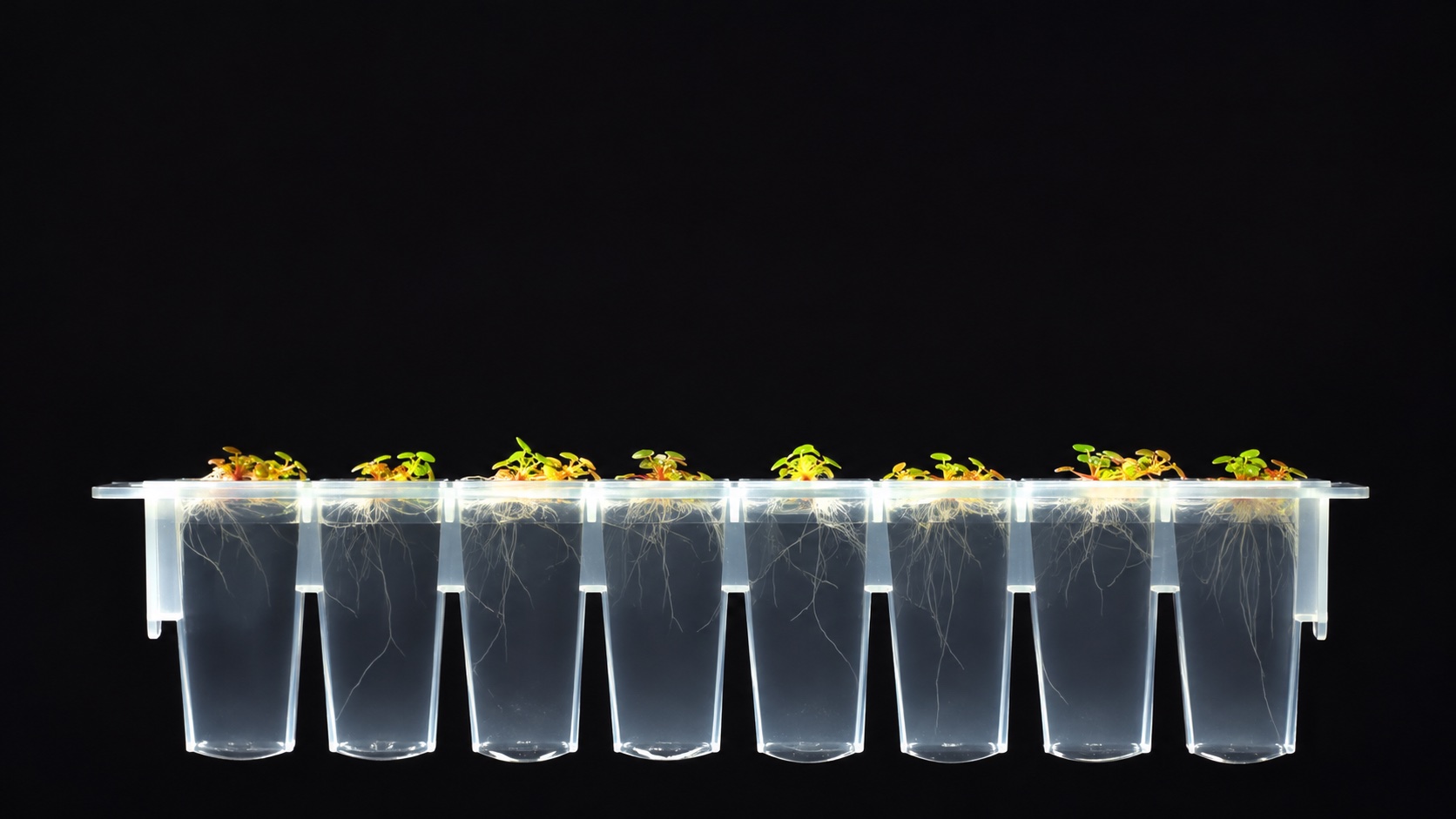
Plant microphenotyping is used in agriculture technology laboratories to screen for potential biostimulant compounds that can increase crop yields and resilience. Automation of the microphenotyping workflow on Tecan’s Fluent® liquid handling platform has been shown to increase speed and improve the quality and standardization of data.
How biostimulants support sustainable agriculture
With the global population recently surpassing 8 billion, as reported by the United Nations, ensuring the future of the world’s food supply has become a critical international priority. As the population grows, arable land becomes increasingly scarce, and farmers are challenged to produce more food with fewer resources, all while contending with complex issues such as climate change, soil degradation and water scarcity. At the same time, there is a growing demand for sustainable agricultural practices that can increase crop productivity while minimizing environmental impact.
In response to these challenges, the adoption of biostimulants, a diverse group of compounds designed to enhance plant growth and resilience, is expanding rapidly worldwide, particularly in regions focused on sustainable intensification and organic farming. Biostimulants, which can be natural or synthetic, are applied to plants or soils to stimulate natural processes that improve crop yield, growth and stress tolerance.
Unlike traditional fertilizers that supply nutrients directly, biostimulants work by enhancing nutrient uptake, increasing tolerance to abiotic stresses such as drought or salinity and promoting beneficial soil microbial activity. Common examples include seaweed extracts, humic acids, protein hydrolysates and beneficial bacteria or fungi.
Syngenta Biologicals: Advancing biostimulant research
A global leader in this field, the Swiss-based Syngenta Group is the world’s largest agricultural technology company by revenue, employing over 55,000 people across more than 90 countries. Syngenta Biologicals, a key division within the group, holds a leading position in the development of Biologicals, which include biostimulants, biocontrols and nutrient use efficiency (NUE) products.
The challenges of manual microphenotyping and biostimulant screening
Much of Syngenta Biologicals’ biostimulant research is conducted at the Atessa Research Center in central Italy. Senior Principal Scientist Ana Karine Martinez Ascanio explains: “At the Atessa site, we have three Research Units dedicated to Plant Science, Microbial Science and Chemistry. In total, approximately 40 researchers are based here.”
Senior Scientist in Plant Physiology Mattia Fois adds further insight: “Screening potential new biostimulant compounds has traditionally been a manual and time-consuming process. Before introducing automation, for nearly a decade, we had to sow Arabidopsis seeds manually one by one onto growth media in deep well Phytostrips. With potentially thousands of compounds to screen each year, this manual workflow could easily become a bottleneck.”
A turning point came in 2013, when Ana Karine encountered a poster at a scientific congress that described a robotic, miniaturized plant phenotyping platform developed by researchers at the University of Lancaster, UK. “We immediately saw the potential for our work,” Ana Karine recalls. “We reached out to the Lancaster team, and this marked the beginning of a highly productive collaboration, including visiting the UK to fully understand their methods.”
Mattia continues: “Microphenotyping involves observing and comparing the growth of plant seeds in several Phytostrips, each containing different biostimulant candidates. While this process is ideal for initial screening, as mentioned, manual seeding is labor-intensive, and standardizing root and shoot growth measurements is challenging. The work in Lancaster inspired us to consider automation.”
How automation supports microphenotyping
However, fully automating the workflow with a standard liquid handler proved difficult, especially for the seeding step. In 2023, the Atessa team partnered with Tecan to adapt the microphenotyping workflow to the Fluent liquid handler. Following an initial proof-of-concept by Tecan’s presales specialist Fabio Maretto, Tecan’s Labwerx group developed a customized solution on the Fluent 780 liquid handler, including a customized support for the Phytostrips, custom robotic fingers for handling and movement plus the integration of a PhytoBooth imaging device from Robiotec Ltd. Extensive testing enabled the standardisation of Phytostrip filling with growth medium (Phytagel), the reproducible automation of seeding as well as imaging of the Phytostrips. After installation, the workflow was completed with the integration of a second imaging system from Robiotec (Platebooth) for sowed microtiter plates delivering fully automated coverage.
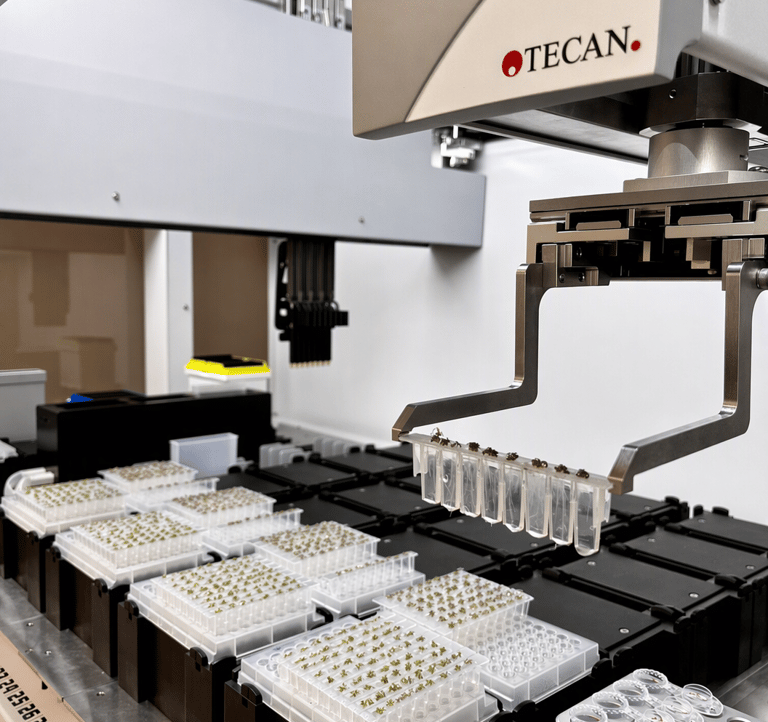
The benefits of automated liquid handling: Faster seeding and improved data quality
Mattia has been impressed with the results: “Since implementing the Fluent system, the time required to seed Phytostrips has decreased nearly tenfold, and we’ve seen significant improvements in data standardization and quality. Another key benefit is the elimination of human error in transcribing image names captured by the imaging system.”
He also highlights broader advantages: “With a versatile system like Fluent, colleagues can run other plate-based methods on the same instrument, further increasing our efficiency.” Regarding Tecan’s support, Mattia notes: “The support we received during development and installation was excellent, and we truly value the partnership. Looking ahead, I see an increasing role for AI agents in error analysis and script development, and I hope Tecan will continue to support us in this direction.”
The collaboration between Syngenta Biologicals and Tecan exemplifies practical innovation and partnership in overcoming laboratory challenges. As Ana Karine concludes: “We believe we are the only company applying such an automated approach in the biostimulants field. It aligns perfectly with Syngenta Biologicals’ ambition: innovation powered by nature!”