








Officinae Bio, a synthetic biology start-up based in Italy, has developed an AI-based software platform to aid the design of DNA vectors for drug discovery. The company is combining this powerful technology with automated synthesis and assembly processes to accelerate the production of novel drug candidates, reducing hands-on time, enhancing traceability and ensuring process integrity.
Nucleic acid therapeutics – including gene and mRNA therapies – have the potential to transform the treatment of many incurable diseases. Unfortunately, current clinical research efforts are being hindered by a lack of tools for efficient and cost-effective production of DNA and RNA molecules for drug discovery. Venice-based biotech company Officinae Bio was set up to address this issue and help accelerate the translation of nucleic acid-based products into clinical solutions.
The company has developed an AI-based software platform, Mercurius AI, to devise the most effective route for the assembly of custom RNA and DNA sequences to be used in cell and gene therapies. These sequences are then synthesized on automated liquid handling platforms, saving staff time while ensuring reproducibility, traceability and data integrity. Officinae Bio CEO Davide De Lucrezia explained: “By investing upfront in software and algorithms, we can save time and frustration further down the line. Many candidate therapeutics simply do not work, or prove impossible to synthesize, and a lot of time is lost. One way of mitigating these problems is to use software algorithms to establish the best way to build the required sequences.”
Davide continued: “I began my career as a synthetic biologist, then moved into computer science and machine learning with the aim of finding better ways to design processes and sequences to increase the success rate in the lab. I like to use the analogy of a symphony orchestra, where everybody is focused on the first violin, because that's what really makes the masterpiece. The gene of interest is the equivalent of that violin, but you also need the rest of the instruments to compose a masterpiece. In the case of mRNA, you need upstream and downstream non- translating regions, a poly(A) tail, chemical modifications and capping strategies to translate that genetic sequence into something that will have an impact in cells and, subsequently, in vivo.”
“The first step is for the customer to upload their gene of interest to our web portal, then the software provides a range of non-coding regions to choose from based on the intended application. It also checks for design flaws to ensure that the custom sequence meets the criteria specified and can be manufactured effectively. Finally, the software suggests a preloaded configuration, including capping strategies and modifications, as well as detailing the scale and purification steps needed. The idea is to take the input sequence for the gene of interest and deliver a ready-to-go solution that allows the customer to move to testing faster.”
“Once the online process is complete, the digital data needs to be translated into a physical nucleic acid sample with all the correct attributes. In the past, the information was transferred in a Microsoft Excel® file to an operator at the bench, who would then synthesize the specified sequence. This is a demanding process to perform manually, because of the number of steps and parameters involved, but is ideally suited to automation. We therefore needed an automated liquid handling platform that could perform our synthesis, assembly and quality control workflows, avoiding many manual processes,” said Davide.
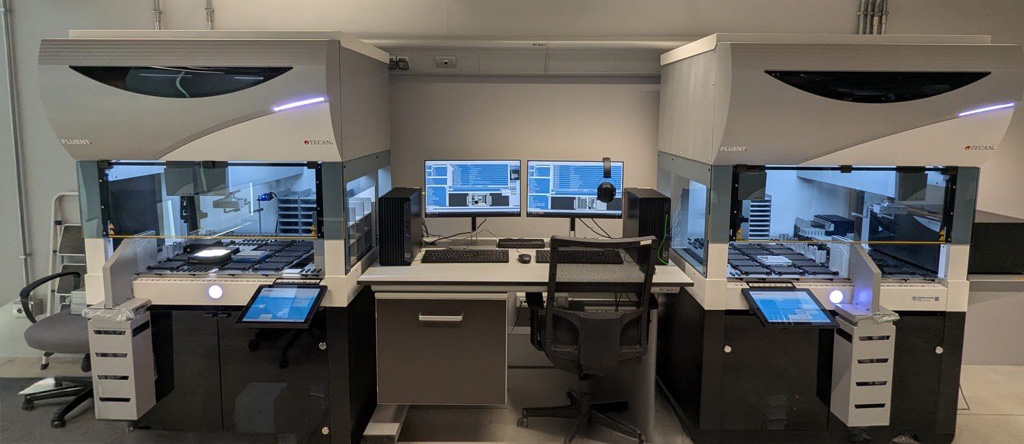
Officinae Bio purchased two Fluent® Automation Workstations equipped with a Flexible Channel Arm™ and a Robotic Gripper Arm™ to manufacture the vectors of interest. The first system incorporates an ODTC® (on-deck thermal cycler, Inheco), three cold plates, a BioShake mixer (Qinstruments), MicroHAWK barcode reader (Omron), and an integrated Infinite® 200 F Nano+ microplate reader for quality control of the nucleic acids. The second platform is configured with a BioShake system and MicroHAWK barcode reader, plus a SciRobotics’ Pickolo™ Colony- Picker for automated colony recognition and picking.
Davide described the process: “We have integrated our software with FluentControl™, allowing our algorithm to translate the digital information into executable Fluent scripts. Most mRNA is manufactured using in vitro transcription, which requires a DNA template, so the first Fluent system is dedicated to DNA synthesis, assembly and quality control. The DNA template is then transferred to the second Fluent to produce the required quantity of purified mRNA with the specified attributes at the stipulated concentration.”
“The Pickolo Colony-Picker on the second Fluent plays a pivotal role in automating our DNA construct synthesis workflow, streamlining three critical stages – colony counting, colony picking and automated plasmid purification – while ensuring accuracy, efficiency and full traceability throughout the process. Colonies are grown on selective media, and automatically detected and counted using the system’s advanced imaging and intelligent analysis capabilities. This is followed by precise selection and transfer of individual colonies into liquid growth media for culture by overnight incubation. Automated plasmid purification is then performed on the same platform, delivering high quality DNA ready for downstream applications. Each stage of the workflow is seamlessly managed and monitored through our cloud-based software, ensuring real-time process control, data integrity and complete traceability across the entire synthetic biology pipeline.”
“Automation offers a number of benefits compared to manual workflows. Firstly, the manual process is very repetitive and time consuming, and errors can creep in. Automation reduces the potential for manual errors and saves time, allowing us to do more in the same time frame, and with the same headcount. There’s also the question of data traceability. Capturing data correctly is vital, and the sheer volume of information involved makes it very hard for operators to collect the data accurately. Automation ensures data traceability and integrity for quality control purposes. Longer term, our software uses machine learning to improve its suggestions for fragment synthesis and assembly. If fragment assembly fails or is sub-optimal, this is fed back into the software and taken into account when designing future sequences, so its performance continually improves. The design-build-test-learn cycle largely happens automatically, helping the software to predict the right fragments efficiently.”
“Tecan spent a lot of time in the lab with us, helping us to set up our first foundry in Venice in early 2025. The company has many years of experience in third-party software integration, from set-up and validation through to ongoing support, which was really beneficial. Automating our liquid handling processes means that we can scale up more quickly; the more you can process, the better the economics. This benefit can then be passed on to our customers – typically in pharma and biotech, but also academic institutions and CDMOs – helping to grow our market share. We are now working with the Tecan team in California to duplicate this set-up at our sister lab at TriLink BioTechnologies in San Diego, and aim to build a network of RNA and DNA foundries around the globe. It’s the start of a long-term partnership,” Davide concluded.
For research use only. Not for use in clinical diagnostics.