










By Guido Cimoli
We usually talk about antimicrobial resistance (AMR) as something a population of bacteria either has or doesn't have. It's convenient, but it isn't quite true. Resistance varies from animal to animal, farm to farm and year to year, and is often present at levels too low for a simple yes/no test to detect.
The useful question isn't just whether a resistant strain is out there. It's how much is being shed, where and which way the trend is going.
A recent three-year study of E. coli in Australian pig herds, published in the Journal of Antimicrobial Chemotherapy, shows what that finer grain makes visible, and why it matters for surveillance.
The problem with one colony
Most AMR surveillance rests on a shaky assumption: that a single bacterial colony, picked at random from one sample, stands in for the whole population. It doesn't. Within a single herd in this study, different animals were shedding resistant E. coli at levels that varied by up to a thousandfold. Pick one colony, once, and you could land almost anywhere on that range, or you could miss a rare but important resistance completely.
Cost makes the blind spot worse. As Tecan described in an earlier article, characterizing a single isolate from start to finish costs around AU$300. Even one of the best national programs in the world (Denmark's) examines only about 193 E. coli colonies a year. That's simply not enough data to catch rare, high-stakes resistances early - exactly when catching them counts.
A platform built around the actual problem
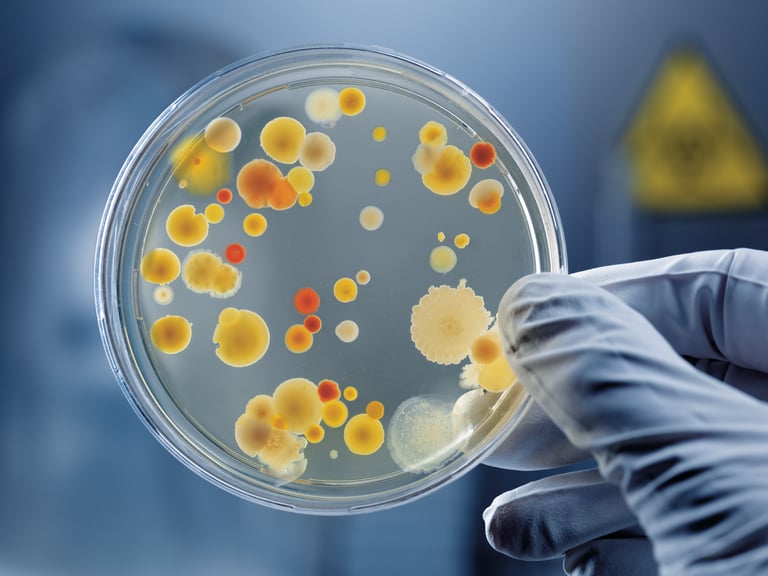
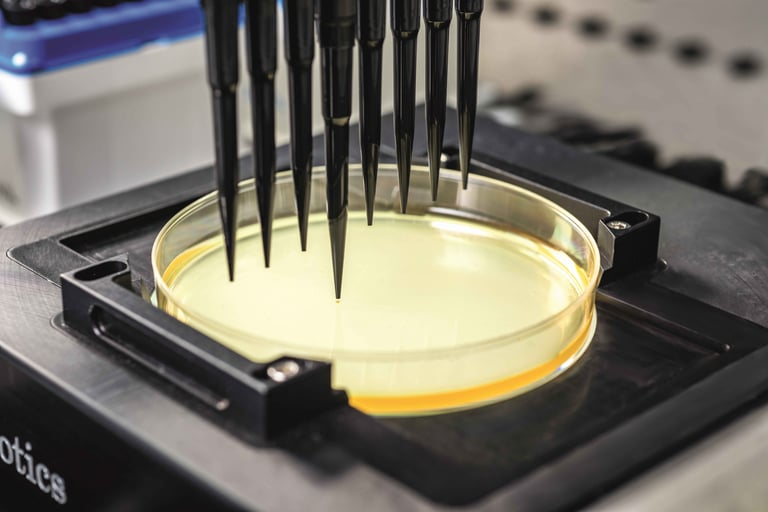
The Robotic Antimicrobial Susceptibility Platform (RASP) was designed for precisely this gap. Samples are spread onto agar plates, grown, photographed and counted, with plating and colony counting automated end to end using a Tecan Fluent® and colony-picking technology. Bacteria are identified and resistant isolates are picked out for confirmatory testing and when it's worth it, genome sequencing.
The key shift is turning a plate into a number, i.e., how much resistance is present across the whole population. instead of a yes/no result from one colony. In this study, that meant screening nearly 900 samples from 10 herds over three years and testing hundreds of resistant isolates.
The same design that clears the throughput bottleneck also lets the low-level stuff show up. Speed and sensitivity come out of the same architecture.
What the finer grain reveals
At population scale, the data sorts itself into three clearly different stories that a simple presence/absence survey would have blurred together.
- The entrenched resistance just sits there. Resistance to two long-used antibiotics, ampicillin and tetracycline, was found in about 99% of samples. It stayed dense and steady across all three years.
- Good stewardship shows up as a measurable decline. Resistance to gentamicin dropped significantly year on year in a quantifiable signal of a population drifting back toward susceptibility as the drug pressure eased. A yes/no survey would have kept reporting "present" and seen nothing move.
- A new problem gets caught early and pinned down. Resistance to extended-spectrum cephalosporins - a class that matters a lot in human medicine — was absent in year one, then began rising. Crucially, it was present at low levels and confined to just two of the 10 herds.
That precision points to a targeted response: checking drug use, biosecurity and animal movements in those two herds, rather than a sector-wide response.
The quantitative data showed what was happening. Genome sequencing helped explain why. The resistant strains matched bacterial lineages found in people and animals around the world, suggesting they were introduced rather than evolving on-site. Some resistance also sat on mobile pieces of DNA that can move between bacteria, making a rare, localized problem worth taking seriously before it spreads.
One detail was particularly telling: fluoroquinolone resistance appeared even though that drug class isn't licensed for livestock in Australia, a clue that it arrived from elsewhere rather than being driven by local use. That's the kind of insight that comes from pairing the quantitative picture with the genetics.
Why this belongs in routine surveillance
The value isn't throughput for its own sake. Quantitative, herd-level data distinguishes an entrenched baseline from a genuine trend, flags important resistance before it becomes established and identifies where acting can make a difference. It can also show, in numbers, when a stewardship measure has worked.
Traditional culture-based surveillance boxes you in: small sample sizes, narrow conclusions. Automation lifts that ceiling and changes what surveillance can see.
Viewed in full resolution, resistance isn't a fixed status. It's a moving, structured, measurable thing, and one you can watch closely enough to act on while there's still time.
If you have questions about AMR automated workflows, contact our expert.
*Based on: Abraham S, Lee ZZ, Jordan D, et al. High-resolution characterization of the temporal and spatial distribution of antimicrobial resistance in Escherichia coli from pigs. J Antimicrob Chemother 2026; dkag196. Platform context from Tecan Journal, "High-throughput automation and genomics for an antimicrobial resistance surveillance system for diverse applications." RASP combines Tecan liquid handling with SciRobotics colony-picking and plating, MALDI-TOF identification and Illumina sequencing.
For Research Use Only. Not for use in diagnostic procedures.
About the author
Guido Cimoli
Guido Cimoli began his career exploring the molecular pathways of cancer, earning a PhD in Molecular Pharmacology before moving to oncology drug discovery research in Genoa and Montréal. Since joining Tecan in 2004, he has helped turn customers' complex lab processes into automation solutions. As Sales Development Manager for Automation in Europe, he works at the intersection of science and technology to deliver practical, high-impact systems that advance research and improve everyday lab work.